
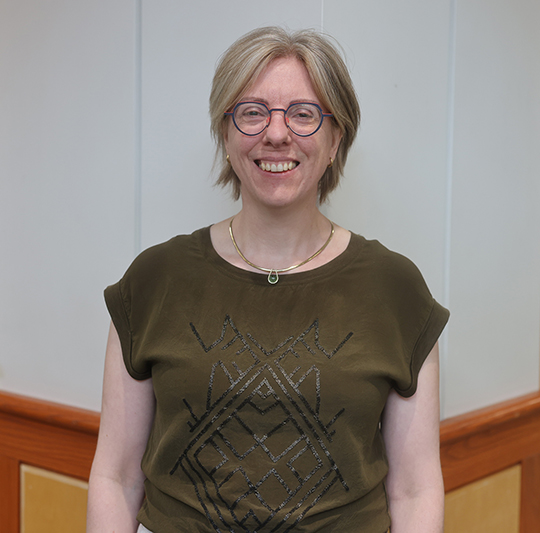
Dr. Maartje Van den Bogaard feels a close kinship with the culture and mission of Arkansas Tech University despite the fact she was born and raised some 4,500 miles away.
“For me, it’s really important that everybody who has the ability and the motivation to be successful in higher education finds a way to have access to that type of education,” said Van den Bogaard, who is a native of the Netherlands. “It’s partly because I am a first-generation student myself. I’ve had a really, really great experience in higher education.
“Everybody (at ATU) is really friendly, and I feel like everybody is truly committed to the success of the students,” continued Van den Bogaard. “People may have different ideas on what that could and should look like, but that commitment and that shared mission is something that is very present here. It’s such an interesting place that focuses on regional development, first-generation students and low-income students. I was very excited about the position and place, so I applied and I’m very happy to be here.”
Van den Bogaard is the new director of academic innovation in the ATU Office of Academic Affairs. Her role is to engage the ATU campus in conversations about the present and future of artificial intelligence, online education, community-centered learning and face-to-face education.
“In higher education, the word innovation was always interesting because very often we talked about innovation as in moving from okay teaching to effective teaching, and we knew what effective teaching looked like,” said Van den Bogaard. “Then, artificial intelligence came, and suddenly we could no longer rely on a lot of our go-to methods for teaching and assessing. We’re forced to re-think what education is about and how we can offer a value proposition to students, the region, employers and so on that continues to make the four-year degree worth it.
“Before AI, innovation was about re-thinking pedagogy, and it’s still about re-thinking pedagogy, it’s just that the boundaries have changed dramatically around it,” continued Van den Bogaard. “I think that makes the challenge bigger and somewhat intimidating…but it is also a really great time to be in higher education and ask ourselves what we can do to help these young people have the best start in their careers we possibly can. Industry is changing in ways we can hardly conceive of. Still, I think it’s universities that are really important drivers in the conversation around what it actually means for all of us as humans, as a society and as a community.”
Van den Bogaard holds a Master of Science degree in education science from the University of Groningen and a Doctor of Philosophy degree in technology, policy and management from Delft University of Technology.
She began her career in the Netherlands as an education coordinator, instructor, consultant and faculty member. She became head of the program of science education and communication at Delft University of Technology in 2018 and remained in that role for three years before making the move to the United States.
Since arriving on this side of the Atlantic Ocean, Van den Bogaard has served as a research associate at both the University of Michigan and Iowa State University, associate professor in the University of Texas at El Paso College of Education and a graduate faculty member at Missouri State University. She also aided the provost’s office with matters related to assessment and accreditation during her time on the Springfield, Mo., campus before moving on to Arkansas Tech in September 2026.
Van de Bogaard’s research has approached student success from various perspectives, including an exploration of complexity modeling to predict student outcomes.
“Student success is not linear, and it looks different for everybody,” said Van den Bogaard. “It was amazing to see that in mathematical models as a truth that exists. This realization continues to inspire me. It means that one size does not fit all. Students have different needs and different pathways, and it is our job as administrators and faculty to help them all get to that finish line of graduation.”
As she tackles some of the larger questions of our time and works with her colleagues to identify answers that apply to Arkansas Tech, Van den Bogaard is aware that students are sensing the pressure of our rapidly changing world as much as, or more than, anyone else.
“I feel a great urgency because there are so many students who are really asking existential questions, and I think all young people ask existential questions,” said Van den Bogaard. “Yet, because suddenly there is this threat of not being able to find an entry position in the labor market, those challenges are very real. As a university, we need to find a way to address that, not just for our students right now, but we need to address it over the next couple of years in order to remain a relevant institution that supports our community and young people.”