It’s a mystery that has perplexed travelers on the west side of the Arkansas Tech University campus for several weeks now.
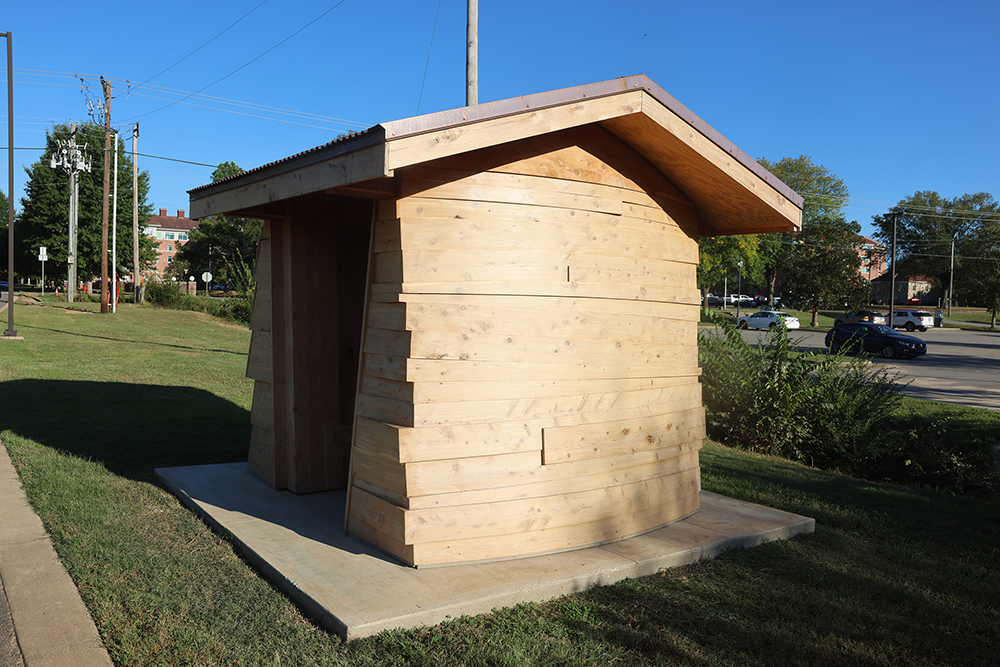
What is that 12-foot tall structure near the intersection of North Glenwood Avenue and the path that connects the ATU campus with the Russellville Aquatic Center?
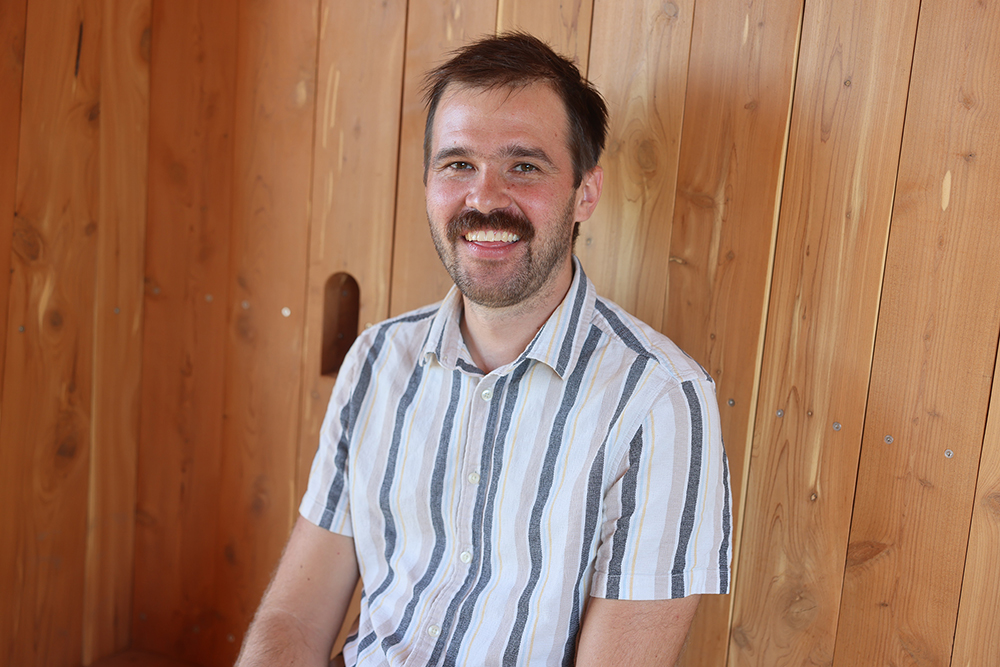
Anders Nienstaedt is the artist who created the mystery item, which is a sculpture entitled “Two Houses (And a Space).”
He finds beauty in the multiple ways his work can be interpreted.
“There are so many things that exist because they have to,” said Nienstaedt. “We organize our lives in these different ways and fall into these different systems. When something falls outside of that, maybe to the point we don’t even know what to make of it or what it is, that is special to me.”
Nienstaedt created “Two Houses (And a Space)” while serving as the Windgate Foundation artist in residence at Arkansas Tech during the spring 2025 semester. Now living in Minnesota, he returned to ATU on Monday, Oct. 20, to provide a lecture about his sculpture and host a site visit at the location of the piece.
A native of Iron Mountain, Mich., Nienstaedt holds a Bachelor of Arts degree in fine art from St. Olaf College and a Master of Fine Arts degree from the University of Wisconsin.
He was inspired to create “Two Houses (And a Space)” after studying dogtrot houses in rural Arkansas. Dogtrot houses feature two living spaces separated by a covered, open-air pathway.
With that vision in mind, Nienstaedt obtained eastern red cedar from mills in Fort Smith and Mountain Home. By shaping the wood and implementing compound angles, he helped his medium find a middle ground between the wood’s rounded, natural form and its rectangular, manufactured form.
Nienstaedt worked on the sculpture for six months, including 10-to-12 hours per day for the final two months. His car survived a broken windshield from transporting all that eastern red cedar and he survived all the long hours in the shop and at the assembly site.
A corrugated copper roof tops the final product, which serves as a stopping point and shelter from the elements for individuals traveling the Russellville Connected Trail System.
“There’s something nice about the fact that I spent a thousand hours on this and then somebody being able to experience it in five minutes,” said Nienstaedt. “I think that’s kind of wonderful. It’s a completely different experience for each one of us, but it was good for both of us and there was an exchange through that.”