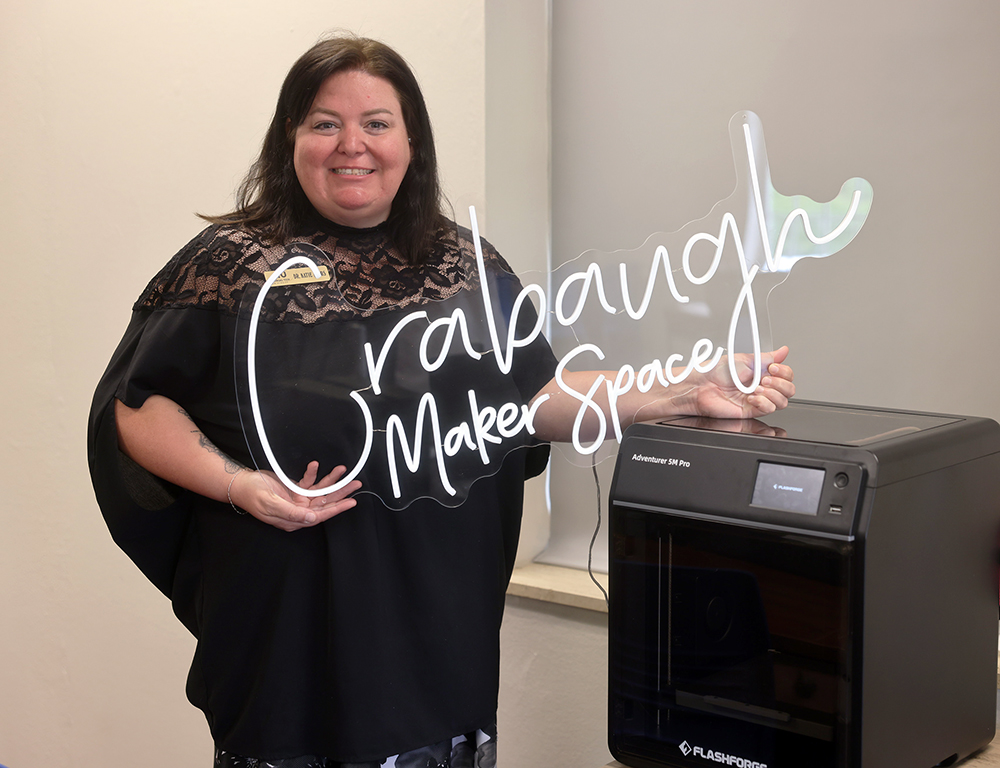
Arkansas Tech University is in the process of developing a makerspace that will help ATU education students learn how to better serve students with autism and other exceptionalities.
“Autism is something that I am very passionate about,” said Dr. Katie Myers, ATU assistant professor of curriculum and instruction and program director for special education in the ATU Department of Teaching and Educational Leadership. “It’s one of the things I require my students to tell me…what are you going to do in your classroom for your students who have been diagnosed with autism? What can that look like?”
Those questions sparked Myers’ desire to provide students with a distinctive real-world experience that would complement their classroom learning. She asked her education students how many of them had ever used a 3D printer. Out of more than 100 students polled, only one had that experience.
Myers’ idea was to send her education students into the field, work with a K-12 student with an exceptionality, identify an issue, gather data related to that issue and then create something to help the student using a 3D printer. Dr. Ellen Treadway, head of the ATU Department of Teaching and Educational Leadership, approved the idea.
Treadway suggested the initiative might be a good fit for grant funding from the new AR-NETWORK (Arkansas Nexus for Excellence in Technology, Workforce, Outreach and Research Knowledge) program.
Arkansas Tech began participating in AR-NETWORK during the 2025-26 academic year under the leadership of Dr. Julie Mikles-Schluterman, ATU professor of sociology and director of the ATU Center for Community Engagement and Academic Outreach.
“I talked with (Mikles-Schluterman), and she was immediately supportive,” said Myers.
The ATU Department of Teaching and Educational Leadership identified a computer lab on the third floor of Crabaugh Hall with 30 workstations as the ideal location for a new makerspace. It now includes two 3D printers that ATU education students are using to solve problems for K-12 students with exceptionalities.
“It’s been really interesting for my students to come to me and say ‘I think this would be great,’ but we don’t know yet if it’s going to be great,” said Myers, who explained that patience and reflection are the most important traits of a special education teacher. “But then they get to print it out, take it out to the field and collect data again. They find that this works or they need to modify that.
“For example, we had a student struggling with fine motor skills,” continued Myers. “They needed a different kind of pencil grip…not the kind you can buy in stores. We printed one, but the print design would not fit over a regular pencil. So, it took us going and buying a regular, everyday No. 2 pencil and getting the design just right so that it would fit snug on there. Mistakes happen, but we learn from mistakes. It’s neat to watch the light bulbs go off and see our students discover how they can use 3D printing in the classroom.”
Once complete, the Crabaugh Hall makerspace will feature not only the 3D printers made possible through AR-NETWORK, but also virtual reality headsets and a laser engraver made possible by a U.S. Department of Education GEAR UP (Gaining Early Awareness and Readiness for Undergraduate Programs) grant that ATU earned in 2024.
In addition to ATU education students, participants in summer GEAR UP programming for students in the Russellville and Clarksville school districts will also have access to the Crabaugh Hall makerspace.
Myers said the effects of the makerspace will eventually extend beyond the borders of the United States to Ray of Hope Academy in Cameroon, which is operated by ATU alumnus Ernest Ehabe and serves a high population of students with autism. She plans on printing some of the same items that have helped students with exceptionalities in Arkansas and sending them to Cameroon to learn how they serve Ehabe’s students.
“By doing this project and having this makerspace, we are helping our students think beyond what is in the textbook,” said Myers, who noted that the Crabaugh Hall makerspace will be fully functional by fall 2026. “They are taking these real-life experiences and realizing how big of a spectrum it actually is. We can’t just put it in a box.
“Autism looks very different in everyone who has autism,” continued Myers. “I don’t want them to prepare for the stereotypical characteristics. I want them prepared for everything. We are approaching it as, ‘how do you teach to your whole class?’ We’re not having them go out and look for problems. We’re having them go out and recognize problems. We want them to recognize that they can improve this student’s life by printing this on a 3D printer. I would love to go out, watch my former students teach in their classrooms and see a little 3D printer. I truly have the best students. They are game changers. They are changing the world and making a big impact.”