
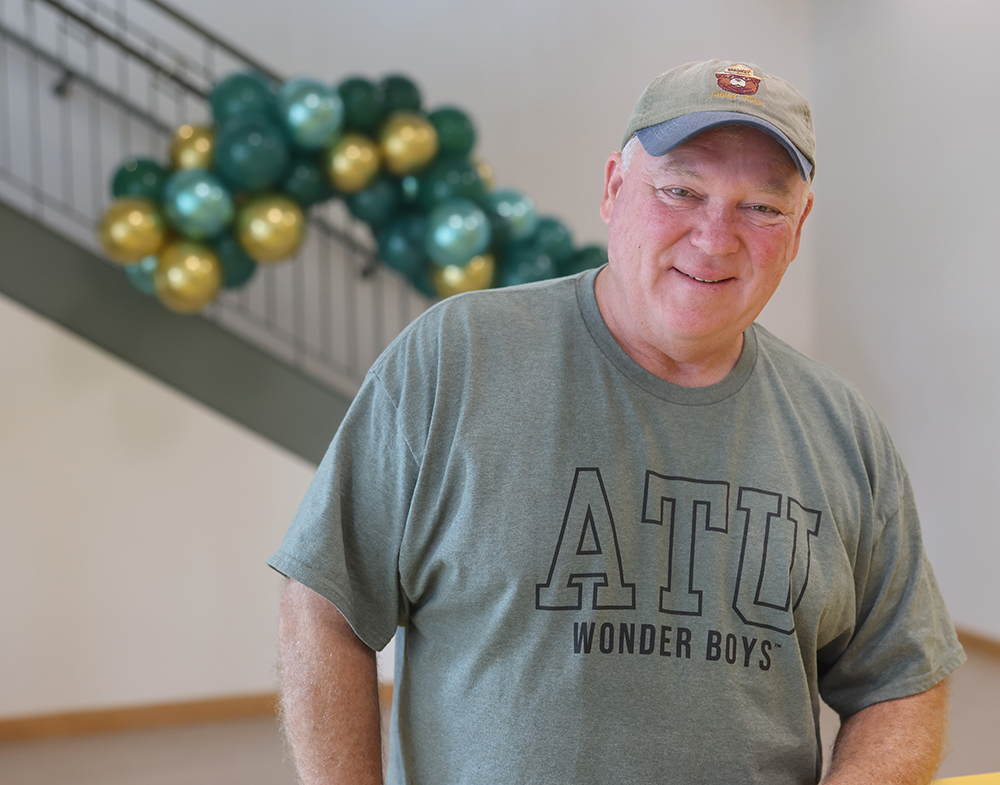
Bill Jackson approached the registration table at the 2026 Arkansas River Valley Wildland Fire Academy at Arkansas Tech University.
As he made his way to the front of the line, it occurred to him that this would mark his first time as a student in an ATU classroom in more than four decades.
During the years in between, Jackson helped create training programs that benefited public lands, the people who work them and the people who visit them around the United States.
“The biggest thing is communication…learning how to talk to people,” said Jackson. “That is what young folks have to do. They have to challenge themselves and develop relationships. You have to get out and make those contacts.”
A native of Mount Ida, Jackson’s association with Arkansas Tech began when he started attending band camp on the Russellville campus in 1974.
As the time to make his higher education choice approached, Jackson’s affinity for Arkansas Tech was enhanced by the facts that it offered the state’s only recreation and park administration degree program and his girlfriend was going to attend there.
Despite those positive factors, Jackson’s pursuit of an Arkansas Tech education was placed in peril when his dreams of gridiron glory dissipated.
“I came up here thinking I was going to play on the football team, and that lasted about two weeks,” said Jackson. “I realized I wasn’t nearly as big as I thought I was. I had given up my band scholarship to play football, so I packed my little bag, walked across campus and talked to Mr. (Hal) Cooper. He said he couldn’t give me my scholarship back, but he said if I would come and play in the fall, I would get one in the spring. That’s what happened, and that’s one of the biggest things that really helped me out.”
Jackson fondly remembers his days as a member of the ATU marching band, Arkansas’ Band of Distinction, and the friendships he gained through the band and his classes.
“I immediately started building relationships, and the most wonderful thing is I still have those relationships 40 years later,” said Jackson. “I can call up some of the folks I was in class with and had experiences with, and we just have that relationship.”
Jackson also built relationships with his faculty members, including Dr. Sheila Dunaway Bathke and Dr. C.D. Dowell.
“He cut no corners,” said Jackson when remembering Dowell. “He prepared you to work for someone who would really challenge you at times. It really got you prepared…loving you the entire time, but it was that tough love that he had.”
Jackson completed his Bachelor of Science degree in recreation and park administration from Arkansas Tech in 1985, but he already had professional experience in the field five years before completing his undergraduate education.
“I actually began my government career with the U.S. Forest Service back in 1980, working there in my hometown of Mount Ida,” said Jackson. “When I came to Arkansas Tech, I was introduced to the U.S. Army Corps of Engineers.”
It was an introduction that led to 35 years with the organization. Jackson worked for the U.S. Army Corps of Engineers in Kentucky, Tennessee and Arkansas.
For 22 of those years, Jackson was an instructor for the U.S. Army Corps of Engineers park ranger training program. In the mid-1990s, he provided leadership for a revitalization of hands-on, personal protection training for rangers as well as tactical communication training that allowed rangers to better mitigate tense situations in the field.
“With that, we developed the very first CD training program for the Corps of Engineers,” said Jackson. “It went all over the country. As part of that, we changed the training requirements. Every year they had to have eight hours of additional training. Everyone had to go through the same training, so it was uniform across the country. I look back on that, and that’s probably what I am most proud of.”
Jackson’s career came full circle in 2016 when he returned to the U.S. Forest Service.
“This opportunity was the answer to a lot of prayers…doors just started opening up,” said Jackson, who serves as forest recreation program manager in the Ouachita National Forest. “What it allowed me to do was get back involved in day-to-day operational stuff from the ground up and try to teach young folks…pass on and mentor them. This position has been one of the best positions I’ve had. Every day, I feel like this is not really a job because I’m enjoying it so much.”
As a result, Jackson has delayed his retirement on four separate occasions. He’s going to try again on Dec. 31, 2026. If this attempt at retirement is successful, he plans on continuing to serve the U.S. Forest Service as a volunteer coordinator. He will continue to go out on fire detail, and he will continue advocating for educational opportunities for students interested in pursuing careers in public lands.
Regardless of his employment status, it’s easy to tell that Jackson will remain passionate about public lands and paying forward all they have given to him.
“It’s the young people,” said Jackson when asked which aspect of his job keeps him going. “I go into classrooms…talk to them about Smokey the Bear and the world around us…and I see the light bulbs come on. For the first time, they’re not scared of that spider, but they’re interested in that spider. You absorb their energy.”