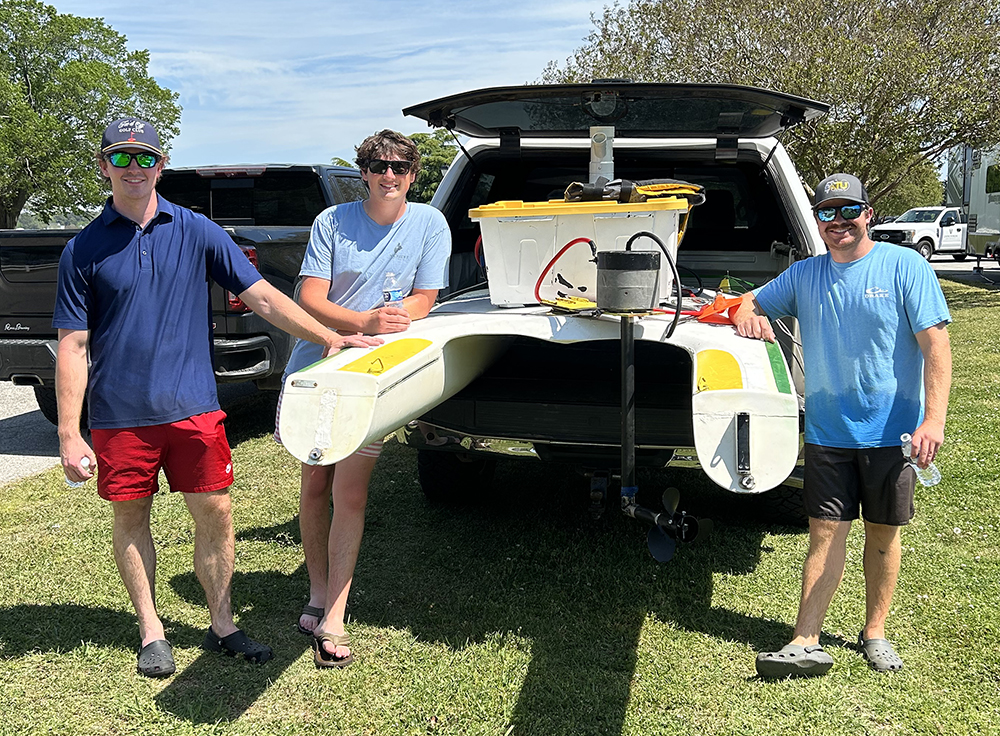
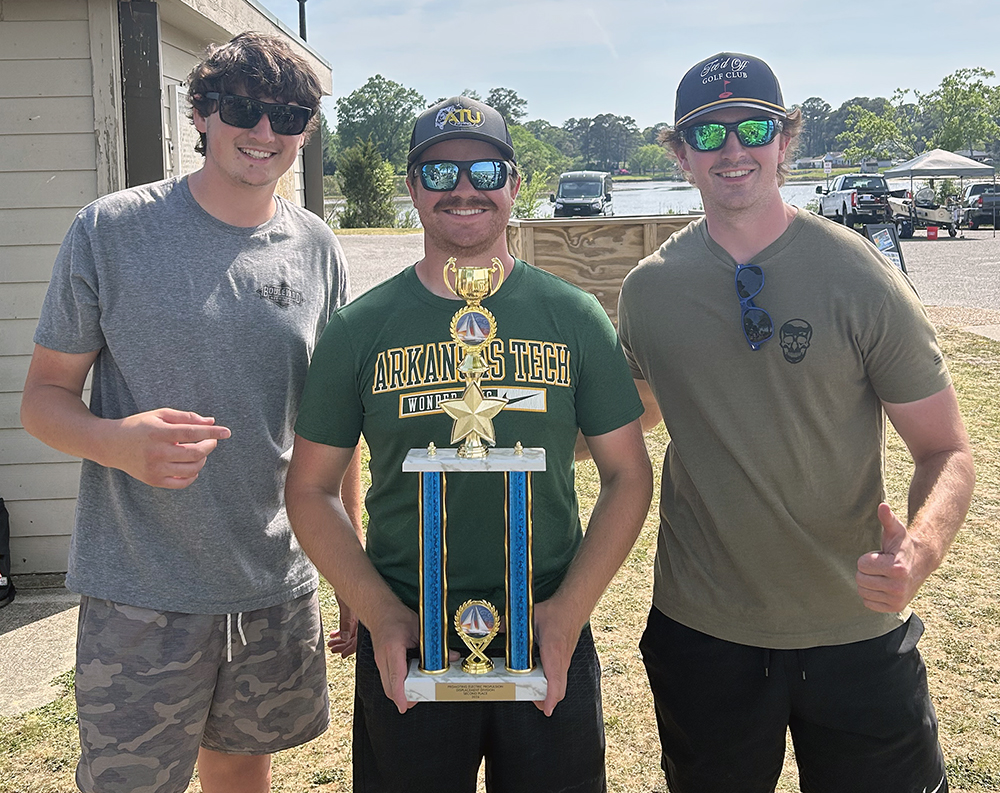
It didn’t take Arkansas Tech University engineering students Michael McCarty, Logan Ashley and Nathan Gibbons long to figure out they had their work cut out for them at the 2026 Promoting Electric Propulsion boating competition.
“We rolled up in Nathan’s F-150 pulling a U-Haul, and all these other, big schools had wrapped trucks, trailers and all that,” said McCarty.
If that wasn’t intimidating enough, they soon encountered Princeton University…and its 34-person team of Ivy League-educated engineers.
“We just did what we knew how to do, and it panned out for us in the long run,” said McCarty.
Arkansas Tech finished top 2 in the nation in the crewed displacement category of the competition, which took place April 14-16 and was sponsored by the U.S. Navy Office of Naval Research and the American Society of Naval Engineers.
It is the third consecutive year that Arkansas Tech has placed top-2 nationally in the Promoting Electric Propulsion competition.
The 2026 event took place in Portsmouth, Va., and featured more than 350 students representing more than 45 colleges and universities from across the United States. A total of 55 electric-powered vessels competed on the waters of the Elizabeth River.
“I feel like our team has a lot of practical knowledge, whereas some of the folks from those higher-end schools…a lot of their stuff is theoretical,” said McCarty. “We could’ve used a little more theoretical knowledge, but in a competition like that, I feel like practical is very beneficial.”
McCarty is a senior mechanical engineering major from Cabot. Ashley is also a senior mechanical engineering major. His hometown is Bremerton, Wash. Gibbons is a senior electrical engineering major from Ozark.
They began their senior project by retrieving the ATU electric propulsion boat from Red Hill on the north side of the ATU campus in Russellville in mid-September 2025.
Soon after, they started the process of determining what they needed to update in preparation for the 2026 competition. They kept the same hull and motor from the existing boat Arkansas Tech teams utilized in 2024 and 2025, but this year’s team re-engineered the vessel’s wiring, steering, electrical system and gearbox.
McCarty, Ashley and Gibbons were advised on their project by ATU faculty members Dr. Mohammad Amjadi, ATU assistant professor of mechanical engineering, and Dr. Carl Greco, ATU professor of electrical engineering.
“Working with the team, having a goal in mind, being able to break that up among ourselves and then seeing that plan come through helped me learn how to work with a good group of guys,” said Ashley.
After several months of work, it was all systems go with 10 days to spare before the team was scheduled to leave for Virginia. That’s when an electric controller on the boat malfunctioned. The manufacturer came through with a rush order that allowed the ATU team to install the new controller and depart for the east coast.
“This project has really helped me apply the theory I’ve learned in the classroom to a real-world application,” said Gibbons. “The willingness not to quit and to dig deep when you hit a roadblock…because we hit several, over and over again…it taught me something about myself. We weren’t going to give up.”
Ashley said conversations the Arkansas Tech team had with event organizers and other teams at the competition site yielded information that could benefit the program moving into 2027 and beyond.
“We know the guys on the (ATU) team next year,” said Gibbons, “and we’ve got some ideas from talking to the other teams that we think could put Tech in the No. 1 spot.”
Learn more about ATU’s engineering programs at www.atu.edu/engineering.