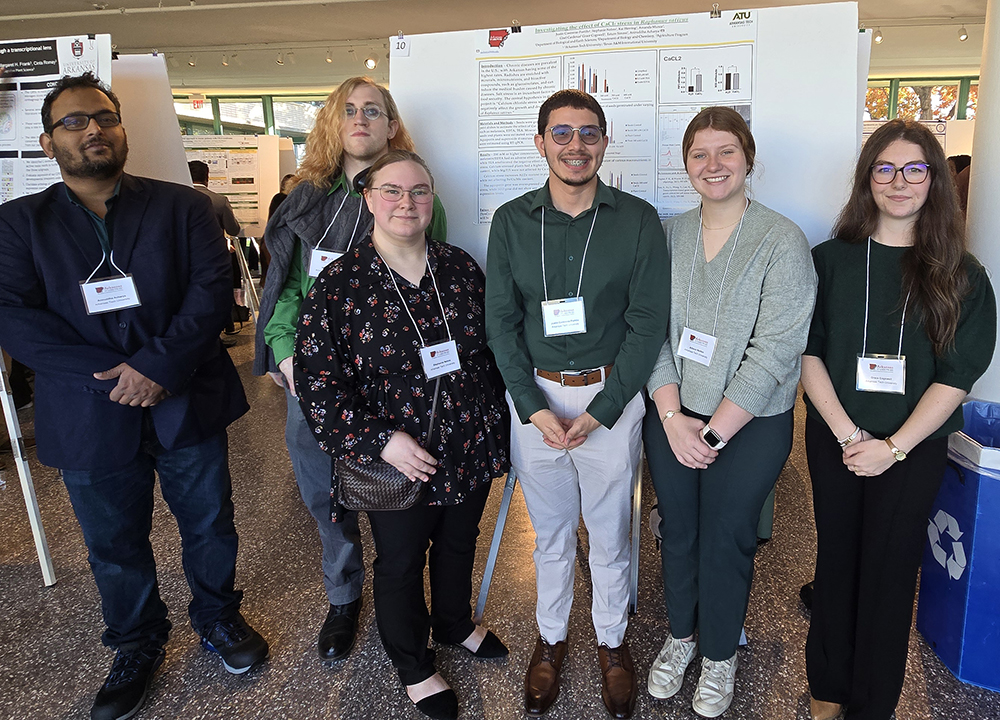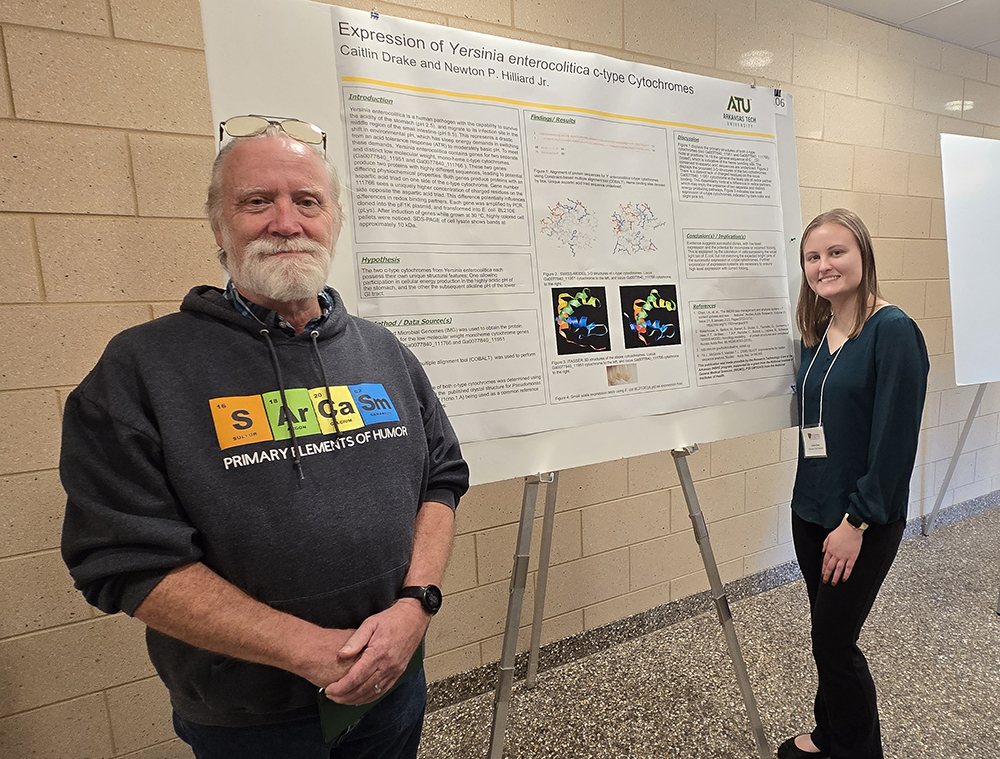
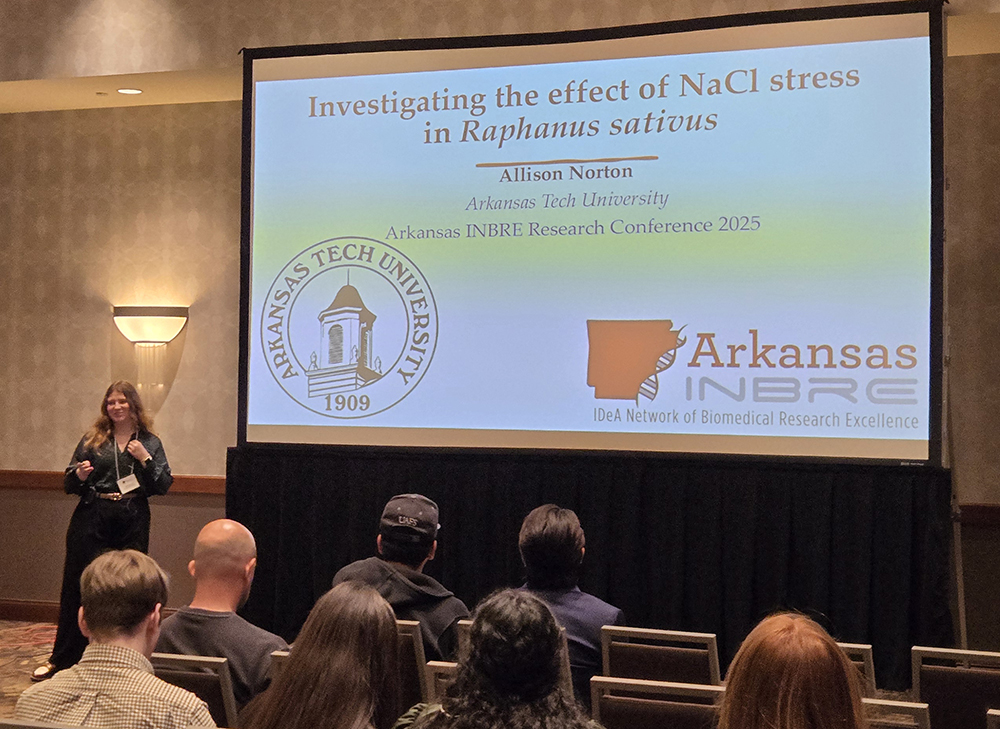
Twelve Arkansas Tech University students presented their research at the 2025 Arkansas IDeA Network of Biomedical Research Excellence (INBRE) Research Conference, which took place at the University of Arkansas in Fayetteville.
Elizabeth Barrett of Midlothian, Texas, Bailee Brinkley of Fort Smith, Luke Cantu of Russellville, Grace Cogswell of Russellville, Justin Contreras-Portillo of Russellville, Caitlin Drake of Dover, Kai Herring of Sheridan, Madyson Johnson of Dardanelle, Stephanie Nelms of Melbourne, Allison Norton of Hot Springs, Mason Oelke of Hartford and David Sierra of Russellville shared the outcomes of their biomedical and life sciences research at the conference Nov. 7-8.
They were guided in their research by ATU faculty mentors Dr. Aniruddha Acharya, Dr. Newt Hilliard and Dr. Tatum Simms, University of Arkansas for Medical Sciences faculty members Dr. J. Craig Forrest and Dr. Shana Owens, UAMS doctoral student Alexx Weaver and Dr. Darby Oldenburg of Gundersen Health System.
“Our students’ participation at the Arkansas INBRE Conference reflects the growing strength of ATU’s research programs and the dedication of our faculty mentors,” said Dr. Michael Bradley, dean of the ATU College of Research and Graduate Studies. “These projects demonstrate the power of hands-on learning, scientific curiosity and collaboration in preparing students for future careers in biomedical and environmental sciences.
“Participation in the Arkansas INBRE Conference underscores ATU’s expanding role in the state’s biomedical research community and its commitment to fostering inquiry, innovation and academic excellence,” continued Bradley. “Through strong mentorship, grant support and statewide collaboration, ATU continues to provide students with transformative opportunities to engage in meaningful scientific discovery.”
Brinkley worked alongside Forrest, Oldenburg, Owens and Weaver to earn an honorable mention award for outstanding undergraduate poster presentation at the conference. Their research project is entitled “Developing a Chimeric MHV68 Encoding an Essential Lytic Antigen from Human Gammaherpesviruses.”
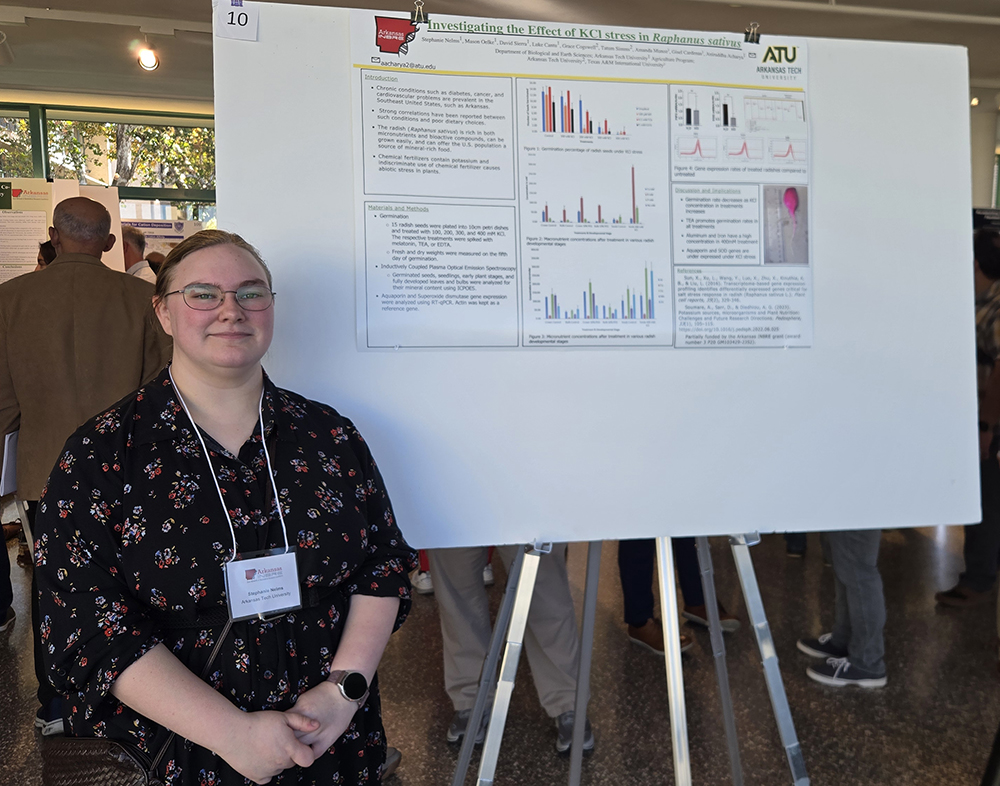
Norton and fellow team members Barrett, Cogswell and Johnson gave an oral presentation of “Investigating the Effect of NaCl Stress in Raphanus sativus,” a study that examines how salt stress affects the germination, growth and nutrient status of radish plants. Acharya and Simms provided mentorship on a project that seeks to provide biotechnological approaches to salt-tolerant crops.
“It’s incredibly rewarding to see our students present alongside peers from across the state and hold their own at such a competitive level,” said Hilliard. “Their creativity, persistence and curiosity are what drive meaningful discovery. Conferences like INBRE give them the chance to see themselves as scientists, not just students, and that’s transformative.”
Sponsored by the National Institute of General Medical Sciences (NIGMS) through the Institutional Development Award (IDeA) program of the National Institutes of Health (NIH), the Arkansas INBRE initiative supports research infrastructure and student engagement in biomedical and behavioral sciences across the state.
The annual conference brings together students and faculty from colleges and universities in Arkansas and surrounding states to share discoveries in biological sciences, physics, chemistry and biochemistry. Hosted by the departments of biological sciences, physics and chemistry and biochemistry in the Fulbright College of Arts and Sciences at the University of Arkansas, the event provides a forum for research collaboration and mentorship.
“The depth and professionalism of our students’ presentations were remarkable,” said Melanie Ewing, interim director of research and sponsored programs at ATU. “Their success at a statewide conference like INBRE showcases the quality of research opportunities available at Arkansas Tech University and the value of investing in undergraduate research experiences.”
Learn more about the ATU College of Research and Graduate Studies at www.atu.edu/gradcollege.