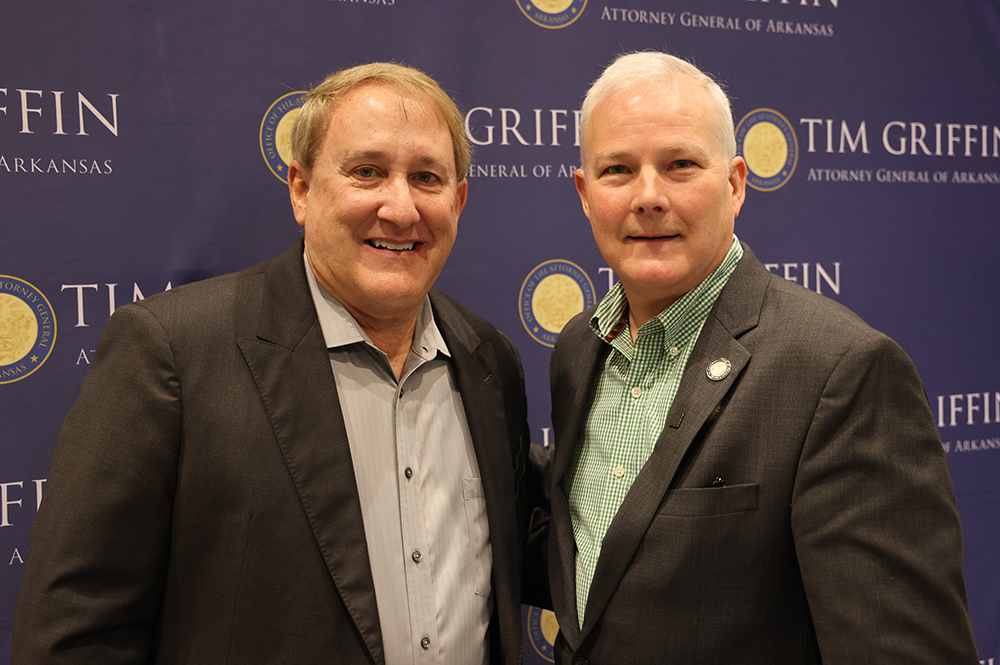
Arkansas Attorney General Tim Griffin continued his statewide push to educate college students about the dangers of fentanyl by bringing his One Pill Can Kill initiative to Arkansas Tech University on Monday, Nov. 17.
“Prevention is about raising awareness and ensuring that you never try it,” said Griffin during a press conference at ATU’s Hull Building Student Union on Monday morning. “That’s the goal. You never touch it. You never try it, and you’re aware of the potential harm that can be done. It’s not hyperbolic. It’s real. It’s accurate. With this stuff (fentanyl-laced illicit drugs), you have no clue what’s in it. One pill literally can kill.”
The press conference was the first of two One Pill Can Kill events at Arkansas Tech on Monday. Later in the day, ATU students participated in a workshop led by staff from the Arkansas Office of the Attorney General. The afternoon session taught ATU students about the dangers of fentanyl, how to recognize an overdose, how to properly administer Narcan and how to access resources to help a friend in crisis.
The workshop drew 277 ATU students, which is the most to ever attend one of the fentanyl awareness events on any university campus in Arkansas.
“In partnership with Attorney General Tim Griffin and his staff, we are gathered here to address a very important public health emergency,” said Dr. Russell Jones, ATU president. “Fentanyl is a synthetic opioid that is 50-to-100 times stronger than heroin or morphine, and it accounts for a large number of opiate-related deaths. This is a clear and present danger for Arkansans, including members of our own Arkansas Tech University community. That is why Arkansas Tech has been at the forefront of both educating our students about the dangers of opioids and fentanyl as well as how to save lives in the event of an opioid overdose.”
As part of the One Pill Can Kill initiative, the Office of Attorney General Tim Griffin supplies fentanyl harm prevention kits to campuses that rollout the program. Each kit contains a fentanyl test strip, a pair of gloves for safety, a safe drug disposal bag and a pill identification card that identifies whether the drug is legitimate medication.
“I appreciate all of you being here today,” said Griffin. “We’re pursuing this aggressive series of meetings like this as part of our overall strategy. Our goal, ultimately, is fewer deaths and fewer people trying illicit opioids. It’s a three-tiered system: prevention, treatment and enforcement. These meetings are really important, primarily for the first two. We want to educate people and raise awareness, particularly on college campuses.”